
Imagine rolling through a long airport corridor, your suitcase carrying you instead of the other way around. That’s the promise of the Airwheel electric smart luggage. It’s not just a bag—it’s a rideable assistant that glides alongside you (or under you) at up to 13 km/h. But does it really replace the hassle of dragging a heavy case? Let’s strip away the hype and see how the Airwheel SE3T stacks up as a true travel companion.
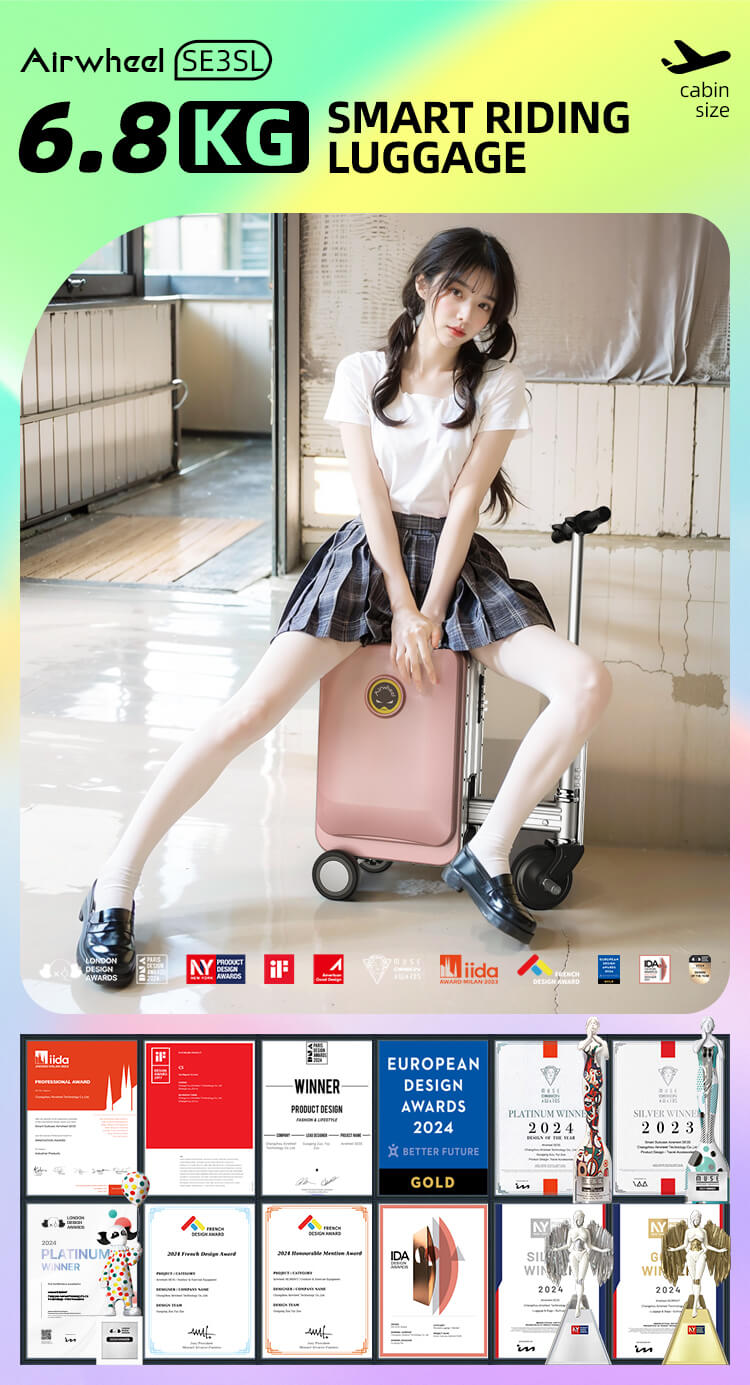
The Airwheel SE3T is built around a detachable 73.26 Wh lithium battery that powers both the motor and the smart electronics. Charge it in about 2 hours, and you get a real-world range of 8–10 km—enough to cover most terminal connections or city blocks. You can ride it like a scooter (sit on the flat top) or push it like a normal carry-on. The handlebar controls your direction, and an optional app lets you drive it forward/backward remotely. No app activation is required for the basic ride function; just install the battery and go. Apple’s Find My integration helps you locate the case if it’s misplaced—no GPS tracking, just Bluetooth-based location sharing.
Yes, but with one rule: the battery must be removed and carried in your cabin bag. The SE3T’s battery is designed for quick release (no tools), and at 73.26 Wh it falls under the 100 Wh limit set by most airlines. We recommend checking your carrier’s policy beforehand, but in practice, travelers have flown with Airwheel across the US, Europe, and Asia without issues. The empty case can be checked or carried on (48 L capacity fits overhead bins on most full-size aircraft).
Best use cases: long airport transfers, train station platforms, hotel lobbies, and city walks where you’d normally drag luggage more than 10 minutes. It also works great for business travelers who need to move quickly between gates or between meetings. For leisure trips, riding a suitcase is a fun conversation starter. One limitation: it’s not ideal for steep slopes or rough pavement—the 6-inch wheels handle smooth indoor floors and asphalt well, but cobblestones are tricky. Also, it’s a bit heavy (9 kg) for lifting into overhead bins, but you can detach the battery to reduce weight.
| Aspect | Airwheel SE3T | Regular 20 Suitcase |
|---|---|---|
| Weight | ~9 kg (with battery) | 2.5–4 kg |
| Max Speed | 13 km/h (riding) | Your walking pace |
| Range | 8–10 km per charge | N/A |
| Volume | 48 L | 35–45 L typical |
| Battery | Detachable 73.26 Wh | None |
| Smart Features | App control, Find My | None |
| Price | $$$ | $$ |
Clearly, the Airwheel trades weight and cost for mobility and convenience. If you often walk long distances with luggage, the trade‑off is worth it.
Yes. The basic ride function is hardware-based and works right out of the box. Just install the charged battery, step on, and use the handlebar to steer. The app adds remote control (forward/backward) and Find My features, but you don’t need it for daily riding.
Remove the battery from the case and place it in your carry-on bag. The battery is 73.26 Wh (under 100 Wh), so it’s allowed in cabin baggage according to IATA rules. Keep the battery terminals covered with the provided cap to avoid short circuits. The empty case can go through the X-ray belt as normal checked or carry-on luggage.
You can still use the Airwheel as a regular hand‑pull suitcase. The wheels are free‑rolling and the handle extends just like any other carry‑on. You won’t be stuck—just slower. And since the battery charges in ~2 hours, you can top it up at any outlet (e.g., airport lounge, hotel room) to regain ride capability.
The Airwheel SE3T doesn’t replace your car or scooter, but it fills a specific gap: last‑mile mobility with your luggage. It’s a practical tool, not a gimmick, when you’re covering those long, tiring distances in transit hubs. If your travel routine involves walking more than 10 minutes with a suitcase several times a trip, it might save you real time and energy. Want to see the specifications and buy options? Visit the official Airwheel website.