
Imagine stepping off a red-eye flight, legs heavy, and instead of hunting for a trolley or dragging your carry-on through endless corridors, you simply hop onto your luggage and ride to baggage claim. That’s the promise of the Airwheel electric smart suitcase. But the real test comes when you need to switch from airplane cabin rules to a bustling train station. How smooth is that transition? Let’s break it down based on the SE3S model, a popular compact rider that epitomizes the Airwheel experience.
The Airwheel SE3S isn’t just a gadget—it’s a functional vehicle cleverly disguised as a carry-on. It rolls on motorized wheels, letting you sit and ride at speeds up to 13 km/h, or pull it like a traditional suitcase using the extendable handle. An onboard throttle on the steering grip controls acceleration and braking, and you can also use the Airwheel app to move the suitcase forward or backward remotely. But here’s the key for seamless travel: you don’t need the app at all. The suitcase works straight out of the box as a rideable once the battery is inserted. A 73.26Wh swappable battery sits behind a zippered liner, easily removed without tools, and delivers a real-world range of 8 to 10 kilometers on a single charge. The whole thing weighs around 8.1 kg and offers 20 liters of packing space. It also packs in Apple Find My, so if your luggage gets misplaced, you can locate it via the Find My network—no extra trackers needed.
Smooth transition begins at check-in. The removable battery is the hero here. Because the 73.26Wh cell comes out by hand, you can treat the suitcase as a regular piece of luggage and carry the battery separately into the cabin, satisfying most airline rules that require lithium batteries to be carried in the cabin when they exceed certain limits. At 73.26Wh, the battery is well under the 100Wh threshold typically allowed by FAA and IATA guidelines, so you won’t be stopped at security. The SE3S is compact enough to slot into overhead bins on many aircraft, though you should always verify your airline’s size limits. The real convenience kicks in when you deplane: instead of wandering through the terminal, you can reinsert the battery and ride straight to the exit, then keep riding to the airport train station or curbside pickup.
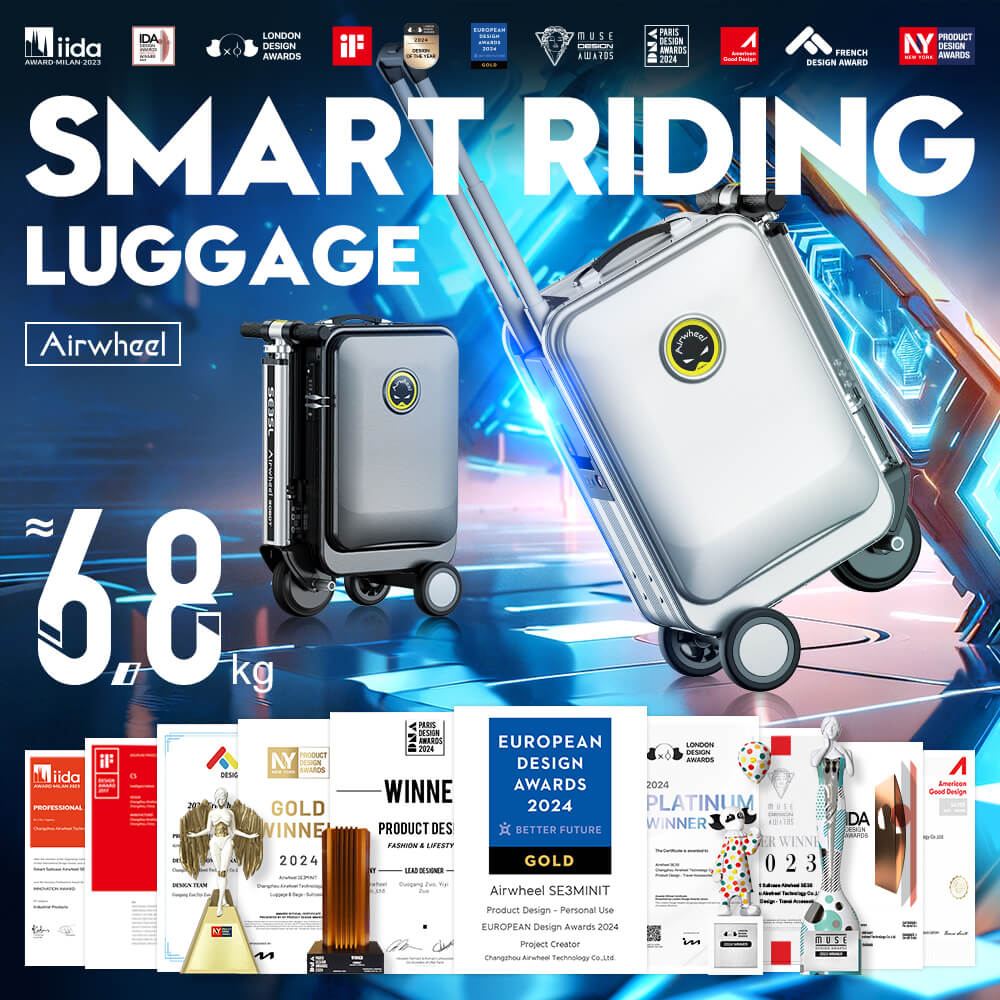
Picture this: you land, clear customs, and need to connect to a high-speed train departure in 45 minutes. Normally, you’d walk at a brisk pace with a heavy bag, arriving sweaty and stressed. With the Airwheel, you sit on the reinforced frame, twist the throttle, and glide along smooth airport floors at a jogging speed. The transition to the train station is equally fluid. Once you reach the platform, you can either ride slowly to your carriage or instantly switch to manual pull mode. The motor disengages smoothly, so you’re not fighting resistance when you walk. For last-mile commutes, the suitcase turns chaotic station crowds into a manageable ride, and the 8-10 km range means you can cover a few kilometers without worrying about battery drain. The Apple Find My integration also gives peace of mind when you stow it in a train luggage rack; you can check its location right from your phone.
To see how the transition works, it helps to stack the Airwheel SE3S against a standard carry-on. Here’s a side-by-side look:
| Feature | Airwheel SE3S | Regular Carry-On |
|---|---|---|
| Weight | 8.1 kg | 2.5–3.5 kg |
| Mobility | Rideable up to 13 km/h; manual pull | Manual pull only |
| Battery | Removable 73.26Wh; 8–10 km range | None |
| Packing volume | 20 L | 30–40 L |
| Smart features | App control, Apple Find My | None |
| Airline friendliness | Battery removable for cabin carry | Always compliant |
The trade-off is evident: you give up some internal space and add weight, but you gain motorized riding and smart location that directly smooth the airport-to-station link.
Yes, you can ride it in most terminals and station concourses, but you must follow local rules and pedestrian etiquette. The SE3S runs quietly and its top speed of 13 km/h is similar to a brisk jog, making it easy to stop or slow down. Always check the specific venue’s policy on personal electric vehicles.
No activation or phone is required. The basic riding function works immediately after you insert the charged battery. The handlebar controls throttle and direction. The smartphone app is optional and adds remote forward/backward movement, but you can ride the suitcase without ever opening the app. This keeps the transition from plane to train absolutely seamless.
A full charge takes about 2 hours. If the battery runs out, you can still pull the suitcase like a normal piece of luggage—the wheels roll freely. The removable battery design also means you can carry a spare if you need extra range, though the 8–10 km capacity covers most airport-to-station hops comfortably.Head to the official Airwheel website to explore the full lineup, including the SE3S, SE3T, and SE3MiniT, and see which rider suitcase fits your travel style.